Why Most Startups Don't Know Their Own Weaknesses (And Why It Costs Everyone)
The weaknesses that sink a fundraise are usually the ones the founder cannot see. Here is why that blind spot exists, why it costs investors too, and how to close it before the first meeting.
AngelHive
AngelHive
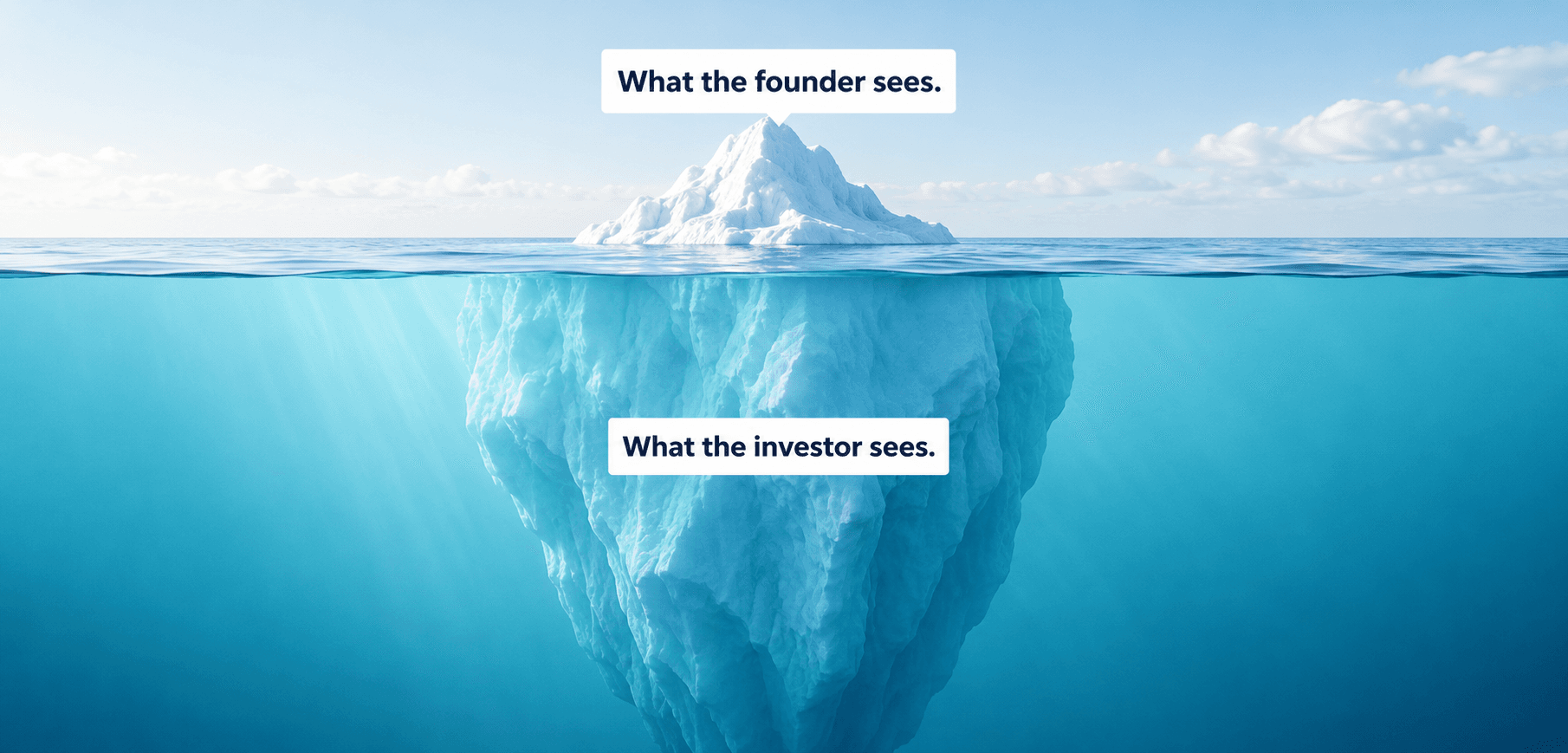
There is a particular kind of silence that happens in investor meetings. The founder finishes explaining their go-to-market plan, and the investor nods slowly, and asks a question that reveals, in about fifteen seconds, a hole in the plan the founder had never seriously considered. The founder has been living inside their company for two years. The investor has been looking at it for ten minutes. And the investor saw the problem first.
This is one of the most common dynamics in early-stage fundraising, and it points to something important: most founders do not have an accurate picture of their own company's weaknesses. Not because they are not smart, but because proximity makes objectivity nearly impossible. The blind spots that are obvious to an outsider are precisely the ones a founder cannot see, because they are standing too close.
This is a problem for founders, obviously. But it is also a problem for investors, and understanding why reveals something about how the whole fundraising process could work better.
Why Founders Can't See Their Own Gaps
The founder's blind spot is structural, not personal. A founder has to believe in their company strongly enough to leave a stable job, convince others to join, and persist through the inevitable setbacks. That conviction is necessary. It is also exactly what makes objective self-assessment so hard.
When you have made the case for your company hundreds of times, to co-founders, to early hires, to your own doubts at three in the morning, the weak parts of the argument get smoothed over through sheer repetition. The market size assumption that was never rigorously checked becomes settled fact. The competitive threat that is genuinely concerning gets mentally filed under "not a real problem" because acknowledging it is uncomfortable. The gap in the team that everyone privately knows about goes unaddressed because naming it feels like admitting weakness.
None of this is dishonesty. It is the natural result of being the person who has to carry the conviction. But it means that by the time a founder walks into an investor meeting, there is often a meaningful gap between how they see their company and how a clear-eyed outsider sees it.
Why This Costs Investors Too
It is easy to frame founder blind spots as the founder's problem. But investors pay for them as well, in a way that is worth making explicit.
Investors spend a significant portion of early meetings doing diagnostic work that the founder should ideally have done already: probing for the weaknesses, testing the assumptions, identifying the gaps. This is necessary work, but when a founder arrives completely unprepared for the obvious questions, the meeting becomes less an evaluation of a fundable company and more a live coaching session on what the founder should have thought through already.
This is a poor use of investor time, and it produces worse outcomes for everyone. The investor cannot properly assess a company when half the meeting is spent surfacing issues the founder is hearing for the first time. The founder, blindsided, often responds defensively rather than thoughtfully, which makes the company look weaker than it might actually be. A founder who had already identified and addressed their key weaknesses would have a more productive meeting, present a stronger case, and give the investor a clearer basis for a decision.
In other words, founder self-awareness is not just good for founders. It makes the entire evaluation process more efficient, which is squarely in the investor's interest.
The Feedback Gap
The obvious fix would be for founders to get honest feedback early, before the meetings that matter. In practice, this rarely happens, for a few reasons.
Most people around a founder are not incentivized to be brutally honest. Co-founders and early employees are invested in the shared belief. Friends and family want to be supportive. Even mentors, who should know better, often soften their feedback to preserve the relationship. The honest, specific, uncomfortable assessment that a founder actually needs is the hardest kind to come by, precisely because everyone close enough to give it has a reason not to.
Investors could provide it, but usually do not, at least not in a useful form. An investor who passes rarely explains exactly why in actionable terms. The rejection is vague ("not the right fit for us right now") because specific criticism takes time, can provoke argument, and carries no upside for the investor. So the founder learns that they were rejected but not what to fix, and the blind spot survives to undermine the next pitch.
What Structured Assessment Changes
This is where structured, AI-assisted assessment changes the dynamic, and it is one of the most genuinely useful things about the way platforms like AngelHive work.
When a startup applies through AngelHive, the company is assessed against a structured framework covering the team, the product, the market, and the financials. The output is not a yes or no. It is a breakdown of where the company looks strong and where it looks weak, generated by a system that has no relationship to preserve, no conviction to protect, and no reason to soften the assessment.
For a founder, this is often the first genuinely objective read they have received. The assessment surfaces the gaps that the people around them were too polite or too invested to name. It does this privately, before the investor meetings, at a point where the founder can actually do something about what they learn. A weakness identified in an assessment is a problem to be addressed. The same weakness discovered live in an investor meeting is a fundraise that stalls.
The value here is not that the AI is smarter than a good investor. It is that the AI is consistent, objective, and available at the right moment, before the pitch rather than after the rejection. It gives founders the honest read that the humans around them are not positioned to give.
Why Both Sides Benefit
A founder who has stress-tested their weaknesses before walking into a meeting is a better use of an investor's time and a stronger candidate for investment. They field the hard questions with considered answers rather than visible surprise. They have addressed the obvious gaps or can explain why they are not as concerning as they appear. The meeting becomes a real evaluation of a prepared company rather than a diagnostic exercise the founder is failing in real time.
For investors, this means the companies reaching them through a structured assessment process tend to arrive better prepared, which makes evaluation faster and more accurate. For founders, it means walking into the most important meetings of their company's life with an accurate picture of how they look from the outside, and the chance to fix what is fixable before it costs them the round.
The blind spot will never disappear entirely. Proximity will always make founders worse judges of their own companies than outsiders are. But the gap between how a founder sees their company and how an investor sees it can be closed substantially, before the meeting rather than during it, and everyone is better off when it is.